Going totally knots with CatmullRom curves

There is some imprecision in my hacky algorithm. Sometimes the cuts are not perfectly centered around the crossing lines.
Going totally knots with CatmullRom curves
There is some imprecision in my hacky algorithm. Sometimes the cuts are not perfectly centered around the crossing lines.
Nice approach to see two layers at the same time. Are you painting with the mouse? Do you use a MIDI controller?
I now wonder if there’s anything for reading graphic tablet pressure and tilt… there was a library called Tablet for Processing, but the link is now 404. I see in my folder that it uses the jpen java library.
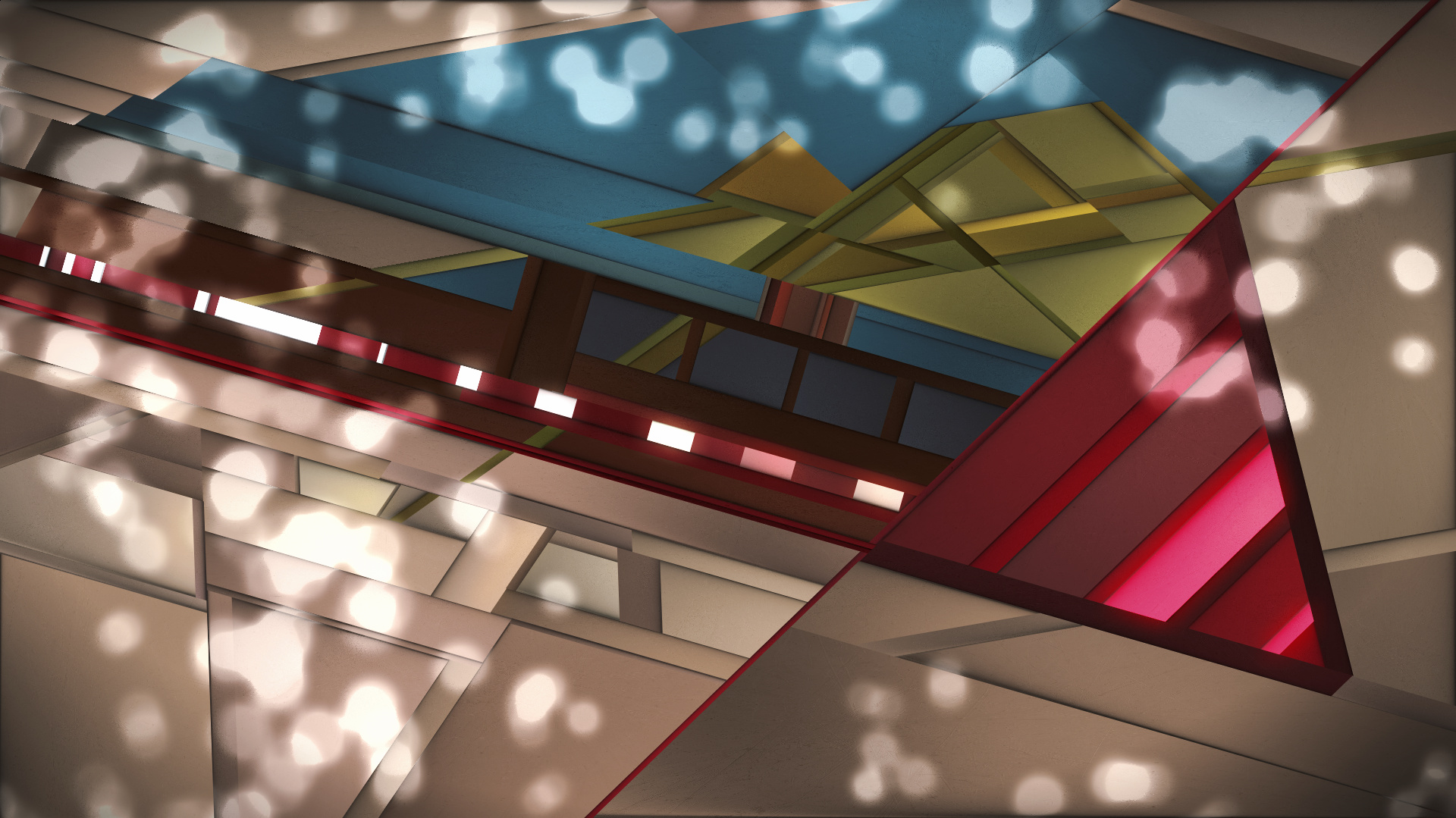
This weeks image: one from June simulating tree shadows. Vignetting and camera simulation via G’MIC:
Here is one that received more attention than I expected on instagram:
Looks very nice!! Is the original animated? Instagram no longer shows anything for me without creating an account 
@abe thanks! yes it is animated. you might be able to bypass instagram’s restrictions if you right-click on the post and open in a new tab. this has worked for me in the past, but not sure if things have changed.
edit: it looks like it may not work
@abe any recommended platforms for sharing animations publicly? imgur?
imgur link: https://imgur.com/gallery/cX4Z2ko
particles with noise flowing outward
Gist with code:
I find it interesting that the video in twitter seems to show some kind of “rendering phase”. It looks like in Blender when the image is first very noise, and the noise is slowly replaced by the rendered image. Why does that happen in your program? Is the shader being applied multiple times approximating the right solution?
You can see some sort of render phase because FractalFilter02 takes multiple iterations to find the nearest distance to the curve.
Note that the filter uses multiple outputs (which I think is not incredibly common use) by using
layout(location=0) out vec4 o_color;
layout(location=1) out vec4 o_solution;
in o_color the filter stores colors, the ones we eventually see on the screen and in o_solution (which is assumed to be backed by a high precision floating point target) it stores the minimum distance and corresponding t value.
The value that is written into o_solution is read through a texture lookup such that the search can continue from the previously best known solution. You will see some tricks where we also use the best known solutions for neighboring pixels.
“Rolling marble”
This one first computes some closely packed circles
The rest is fragment shaders for warping & distortion
also on reddit: https://www.reddit.com/r/generative/comments/ibggiw/rolling_marble/
Very nice  As a kid I enjoyed drawing shiny metal spheres with pencil in school when the class was boring, so this has some sentimental value for me
This started as a pentagon. Points are inserted between existing points when clicking the mouse. Forces are applied to: separate points if too close, bring them together if too separated, avoid sharp angles, vertical wind centered on the screen plus noise based wind.
I started from an idea for mixing the idea of Adobe’s color wheel (which is based on a remapping of HSV and implemented in OPENRNDR as ColorXSVa) and those of the HSLUV color space. That mashup colorspace ColorXSLUVa is part of the upcoming release of ORX, which will include new color tools in orx-colors .
To demonstrate ColorXSLUVa I made a demo that produces this arc based chart:
ColorXSLUVa stretches the hue space such that red-green / blue-yellow line up, as in classical western color theory.
Code for that chart is here: https://github.com/openrndr/orx/blob/master/orx-color/src/demo/kotlin/DemoXSLUV01.kt
Then based on that chart and the new color space I started making compositions like these by messing with the splitter code.
love it!
@abe this is differential growth yes?
I have been working on a version of this algorithm as well.
Based on what I just read at https://github.com/jasonwebb/morphogenesis-resources#differential-growth I would say it’s differential growth inspired, as my rules are not the same. I saw this kind of image from Nervous Systems years ago and tried to do something similar without reading about the algorithm, originally with Processing, and now I ported it to OPENRNDR.
lots of sine() waves layered together. Inspired by Piter Pasma